AI Genome Project
Scroll to watch a single molecule become a double helix — and the idea it led to.
Borrowing DNA’s architecture, not its chemistry
Biological DNA solves a problem every complex system eventually faces: how do you store an enormous amount of structure in a compact, reliable, self-correcting form — and let it build something far more complicated than itself? The AI Genome Project — code-named Kritrima Tvasta(कृत्रिम त्वष्टा, “the artificial fashioner,” after Tvashtr, the Vedic craftsman who shapes all forms) — is Venta Labs’ research layer, asking whether that same architecture has anything to teach us about how AI models are structured, versioned, and passed from one generation to the next.
To be precise about the problem, because it is easy to overstate: models today do inherit. Distillation moves behavior from a large teacher into a smaller student. Continued pretraining resumes from an existing checkpoint for roughly half the compute of a fresh run. Each generation trains on synthetic data written, filtered, and ranked by the last one. Inheritance is not missing.
What is missing is addressability. None of those mechanisms let you name a single capability, lift it out, and put it somewhere else. You cannot meaningfully diff two checkpoints, attribute a behavior to a region of the weights, or ask for “this model, but with that model’s skill at X.” Capability transfer is real, but it is wholesale and lossy — never selective.
So this page does two things. First, it explains real human DNA clearly — the chemistry, the pairing rules, the reason it twists — grounded in established biology. Second, it asks what an addressable genome could mean for a model. The second half is deliberately framed as a vision, not a finished product — we say exactly where the science ends and the idea begins.
The four ideas worth actually understanding
Before the metaphor, the biology. These four ideas are the ones the rest of this page leans on.
1 · The nucleotide is the only building block
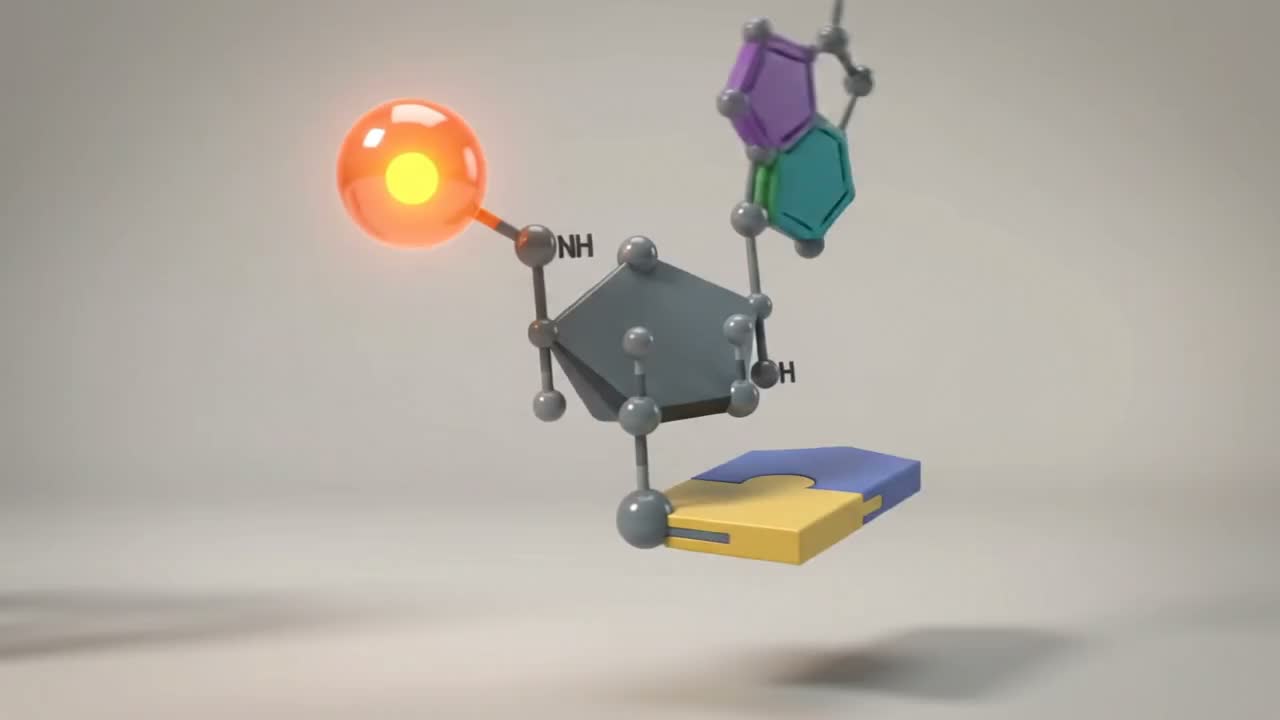
DNA is a chain of one repeating unit — a nucleotide — made of three parts: a phosphate (the connector), a sugar (the body), and a base(the payload: A, T, G, or C). Only the base changes from unit to unit; that’s where all the information lives.
2 · The strand only builds in one direction
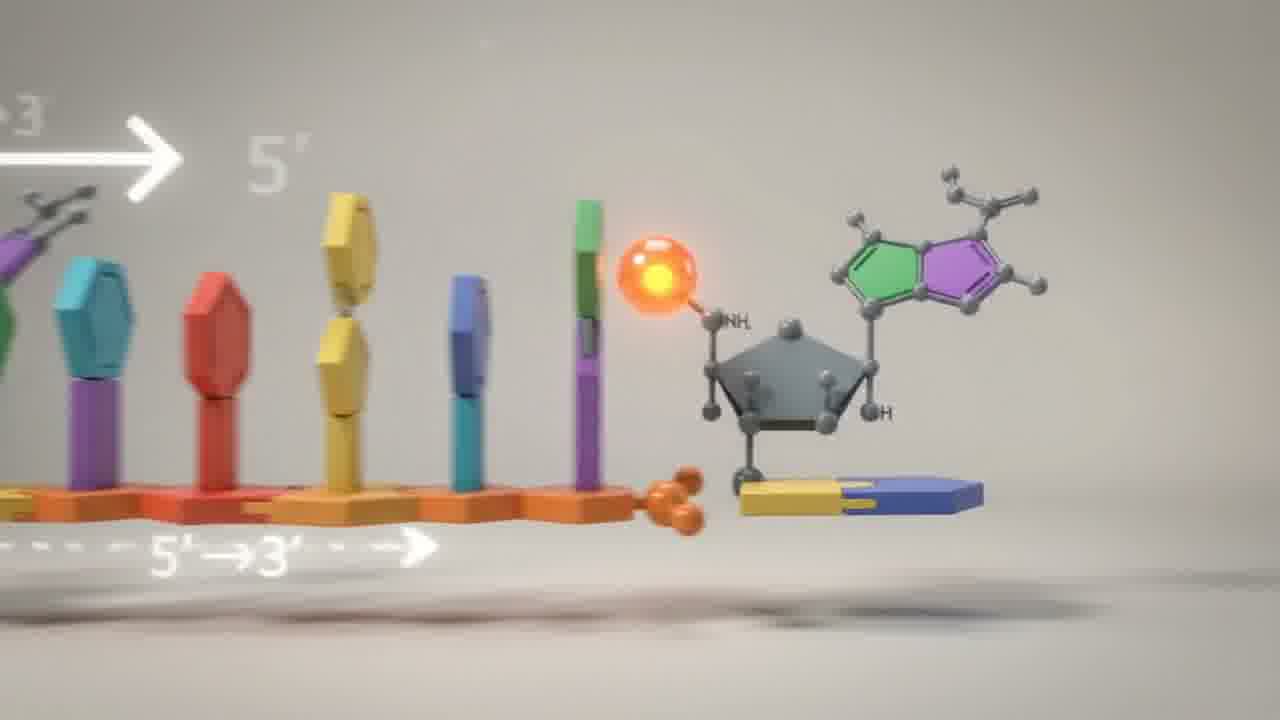
A phosphate on one unit’s 5′ carbon bonds to the open 3′ carbon of the previous unit. That single bond is the only connector — so the whole strand has a direction, and can only be extended at its 3′ end. It behaves exactly like a singly-linked list: append-only, one direction, no going back.
3 · Two strands, held together by pairing alone
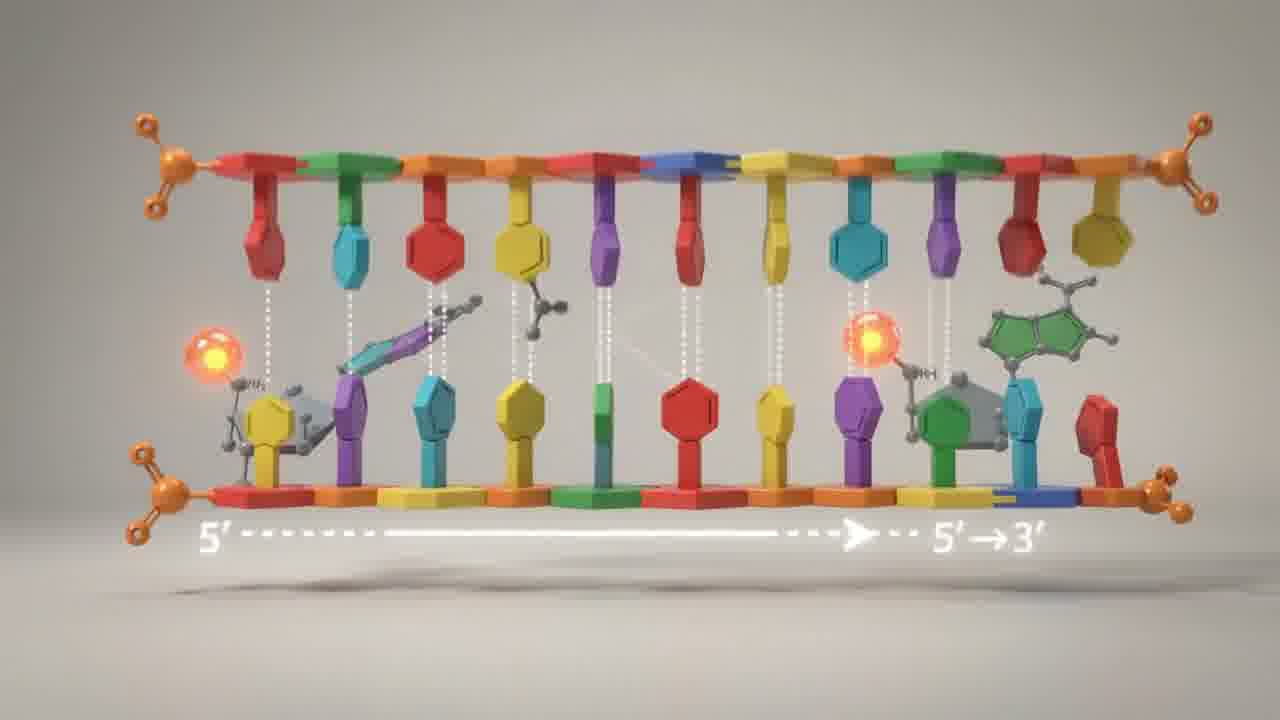
DNA is normally two strands running in opposite directions (antiparallel). Their backbones never touch. What links them is entirely the bases: A always pairs with T, G always pairs with C, joined by hydrogen bonds reaching across the middle. Break the pairs, and the two strands simply fall apart — which is exactly what happens when a cell copies or reads DNA.
4 · The twist is a side-effect, not a force
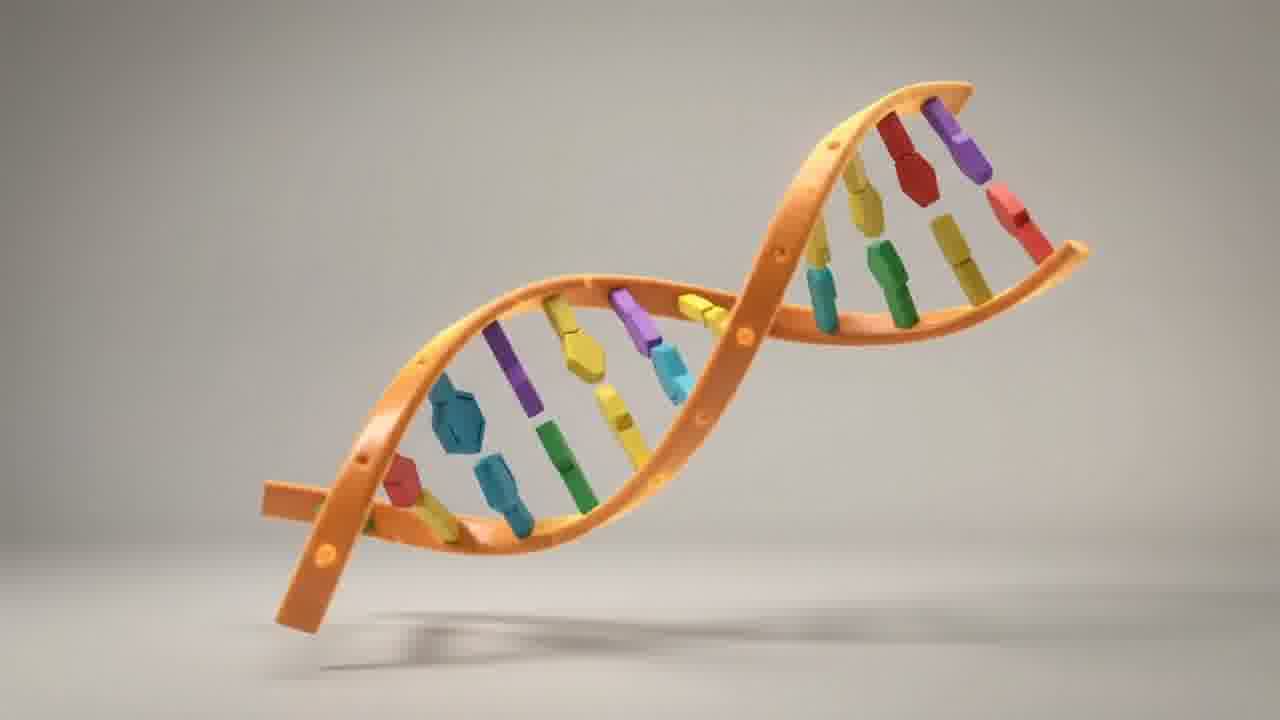
The base pairs don’t pull the strands into a spiral — they just hold each rung shut. The twist comes from two things fighting: the flat bases want to stack tightly (about 3.4 Å apart), but the backbone is slightly too long to stay straight at that spacing. Coiling is the only shape that satisfies both — about 34° of rotation per step, roughly 10.5 steps per full turn.
Notice the pattern: a tiny, fixed alphabet (4 symbols) + a strict pairing rule + directional assembly produces something structurally rich, redundant, and self-correcting. That pattern — not the chemistry — is what the rest of this page borrows.
From a biological genome to an “AI genome”
Here’s the conceptual leap, stated plainly: could an AI model’s parameters, structure, and behavior be represented in a form with the same properties DNA has — compact, self-describing, versionable, and auditable? Below is how the vocabulary might map. This is a working hypothesis, not an existing system.
| Biological DNA | Proposed “AI DNA” analogue |
|---|---|
| Nucleotide — the atomic unit, 4 possible values | A minimal, fixed-vocabulary unit of model information — a discrete building block a model's structure could be decomposed into |
| Base pairing (A–T, G–C) — a strict, exclusive rule | Consistency constraints that keep paired components valid — closer to a checksum or type constraint than a free-form value |
| 5′ → 3′ directionality — one build/read order | A defined, reproducible order in which a model's “genome” is assembled, read, or trained — no ambiguity about sequence |
| Genes — functional segments of the sequence | Modular, nameable capability blocks within a model that could in principle be identified, isolated, or recombined |
| Mutation + selection — small, mostly-corrected copy errors | Controlled iteration — fine-tuning, versioning, or evolutionary search across variants, with guardrails against drift |
| Stacking + twist — stability from redundancy and geometry, not brute strength | Robustness that emerges from structural constraints, not from scale alone |
Everything in the right-hand column above is a proposed analogy, not a claim about how today’s AI models actually work internally. We’re using DNA’s architecture as a source of good questions — not asserting that model weights are literally base-pairing. Treat this table as a design brief, not a specification.
What already exists — and where it stops
This intuition is not new, and the honest version of this project starts by saying so. The closest existing work is task arithmetic: a capability acquired by fine-tuning can be captured as a task vector, the difference between the tuned and base weights (Δθ = θtuned − θbase). Those vectors can be added, negated, and scaled to compose or remove behaviors with no retraining at all. Model merging, LoRA adapters, and model soups all build on the same premise — that capabilities have some modular structure in weight space.
That it works is encouraging: it suggests the modularity is really there. But it comes with a hard constraint — task vectors are only composable between models that share an identical architecture and pretraining run. The moment width, depth, tokenizer, or data mix changes, the arithmetic stops being meaningful. Which is precisely the case we care about: carrying a capability across generations, not within one.
Inheritance across a generational boundary. Existing methods transfer capability wholesale (distillation, continued pretraining) or selectively but only within one architectural lineage (task vectors, LoRA). Nothing yet does both: name a capability, and carry it into a model that isn’t shaped like its parent.
What we’re actually exploring
The long-term question behind this project: could a model’s capabilities be described in a compact, inspectable “genome” — something you could diff, version, partially recombine, or audit, the way you can with a DNA sequence — and could that description survive being moved into a model of a different shape?
We don’t have that solved, and we’d rather say so plainly than overclaim. What we have is a vocabulary borrowed from the biology above, an honest read of where the existing methods stop, and three questions we think are worth pursuing.
The unit question
What's the smallest nameable piece of a model worth treating as a “nucleotide”? Task vectors say “a weight delta.” That works within one lineage — what survives a change of architecture?
The portability question
Is there a representation of a capability that doesn't depend on the shape of the network holding it — so it can move between models that aren't built alike?
The versioning question
Could a model change be expressed as a small, auditable “mutation” against a known baseline — something you could read, review, and revert — rather than a new opaque checkpoint?
Where this goes next
This is early. Here’s the honest state of things.
Framing & existing work
Human DNA fundamentals documented, the analogy defined, and the existing work (task arithmetic, distillation) placed honestly.
Define the unit
Narrowing down what a model's “nucleotide” should be — and what form of it could outlive a change of architecture.
Toy prototype
A small, deliberately simple model encoded and inspected in genome-like form, as a proof of concept.
Research collaboration
Sharing findings and open questions publicly, and inviting scrutiny before claiming more than we can show.
Interested, skeptical, or want to help stress-test the idea?
This is a genuinely open research direction — critical pushback is as useful as enthusiasm.
Get in touch